Full text
Read the complete newsletter
March 26, 2026
In 1958, President Eisenhower created the S-Corporation to give small businesses a "Goldilocks" option: corporate legal protection with the simple, single-layer tax filing of a partnership. Nearly 70 years later, it's still the most popular tax structure for small business owners, but only if you get the details right.
This week’s lineup:
• ! The S-Corp salary rule, explained: The IRS says your salary must be "reasonable,” but they've never defined what that means. Here's what matters.
• " Finding your S-Corp salary sweet spot: FICA wants your salary low. Your QBI deduction wants it high. We'll show you how to thread the needle.
• # This tax mistake costs S-Corps thousands: Your distributions don't have withholding, and the IRS expects quarterly payments. Penalties stack up fast.
• $ Free download — the "Goldilocks" salary worksheet: Done reading? Run the numbers. Find your sweet spot in about five minutes.
Follow us for even more great tips, tricks, and deadline reminders. Facebook | Instagram | LinkedIn
The Basics
!The S-Corp Salary Rule, Explained
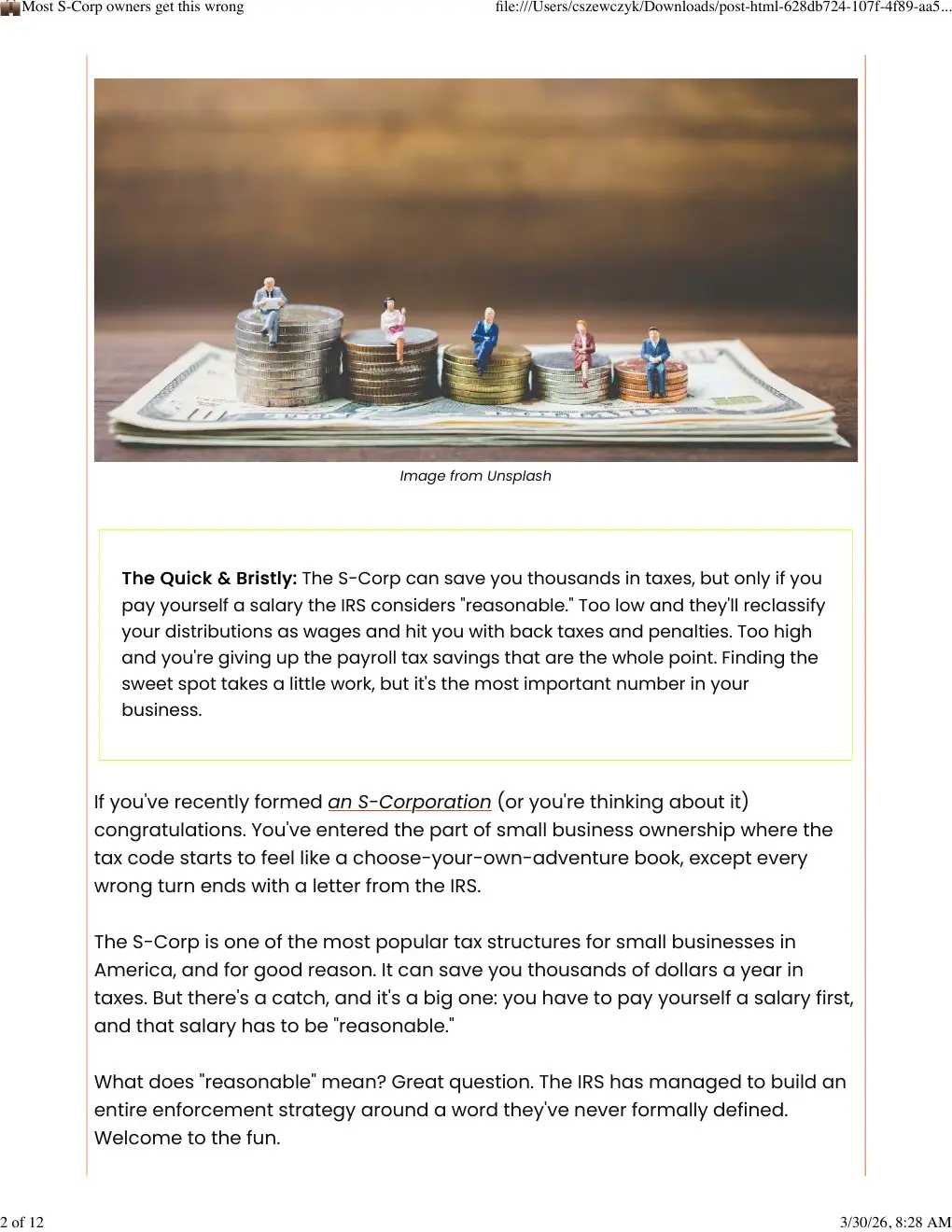
Image from Unsplash
The Quick & Bristly: The S-Corp can save you thousands in taxes, but only if you pay yourself a salary the IRS considers "reasonable." Too low and they'll reclassify your distributions as wages and hit you with back taxes and penalties. Too high and you're giving up the payroll tax savings that are the whole point. Finding the sweet spot takes a little work, but it's the most important number in your business.
If you've recently formed an S-Corporation (or you're thinking about it) congratulations. You've entered the part of small business ownership where the tax code starts to feel like a choose-your-own-adventure book, except every wrong turn ends with a letter from the IRS.
The S-Corp is one of the most popular tax structures for small businesses in America, and for good reason. It can save you thousands of dollars a year in taxes. But there's a catch, and it's a big one: you have to pay yourself a salary first, and that salary has to be "reasonable."
What does "reasonable" mean? Great question. The IRS has managed to build an entire enforcement strategy around a word they've never formally defined. Welcome to the fun.
Why Does the S-Corp Exist in the First Place?
Back in 1958, President Dwight D. Eisenhower signed the S-Corporation into existence. The idea was simple: give small business owners the liability protection of a corporation without the brutal double taxation that comes with it.
In a traditional C-Corporation, the company pays corporate tax on its profits, and then the owners pay personal income tax again when those profits are distributed as dividends. It's like being charged a cover fee to enter a restaurant and then also being charged for the food. The S-Corp eliminates that. Profits pass through to your personal tax return and are taxed only once.
But — and this is a "but" the size of a tax code appendix — the IRS noticed early on that S-Corp owners were tempted to skip paying themselves a salary entirely and just take all their income as distributions. Why? Because distributions aren't subject to payroll taxes. That's a 15.3% savings on every dollar, which is roughly the cost of Social Security (12.4%) and Medicare (2.9%) combined.
The IRS, unsurprisingly, was not amused.
You have to pay yourself a salary, and it has to be "reasonable,” but what does that actually mean? Keep reading →
PRESENTED BY BREW MARKETS
The why behind market moves
The market doesn’t wait for you to catch up. By the time you check your phone, prices have moved, headlines have shifted, and everyone suddenly has a take.
Brew Markets helps you start from a better place.
After markets close, our free email breaks down the day’s biggest moves and explains why they happened — not just that they did — with clear context and smart analysis in plain English.
If you want market coverage that cuts through the noise (without talking down to you), Brew Markets is worth a shot.
Try it for free
Which famous historical figure imposed a tax on beards? (Find the answer at the end of this newsletter)
The Strategy
" Finding Your S-Corp Salary Sweet Spot
Photo from Unsplash
The Quick & Bristly: Once you know you need a reasonable salary, the real game is optimizing it. Pay attention to two numbers: the Social Security wage cap ($176,100) and the QBI deduction wage floor (roughly 28.6% of your profit). Nail the zone between them and you keep more of your money. Miss it and you're either overpaying in FICA or leaving a 20% deduction on the table.
So you've got your S-Corp set up. You understand that you need to pay yourself a reasonable salary. Gold star. But here's the part nobody mentions at the beginning: "reasonable" is just the floor. The real money is in the optimization.
Getting your salary right isn't just about avoiding an IRS audit. It's about threading a very specific needle between two tax rules that, naturally, pull in opposite directions. One wants your salary to be lower. The other wants it to be higher. And you're standing in the middle, trying not to lose money in either direction.
Welcome to the Goldilocks zone.
The FICA Side: Why Lower Feels Better
The whole appeal of the S-Corp is that distributions aren't subject to FICA taxes — that 15.3% combination of Social Security (12.4%) and Medicare (2.9%) that gets pulled from every dollar of salary. The less you pay yourself in wages, the more flows through as distributions, and the more you save.
But there's a ceiling built into the system. Social Security tax stops applying once your wages hit $176,100 in 2025. Every dollar of salary above that cap only owes the 2.9 percent Medicare portion. So if your total profit is, say, $250,000, there's a meaningful difference between a $100,000 salary and a $180,000 salary, but not for the reason most people think. Once you're past the cap, the FICA savings on each additional dollar shrink dramatically.
If your reasonable salary lands near or above the Social Security ceiling, the payroll tax argument for keeping it low gets a lot weaker. You're arguing over 2.9%, not 15.3.
FICA wants your salary low. Your QBI deduction wants it high. So where's the sweet spot? Keep reading →
The Deep Dive
# This Tax Mistake Costs S-Corps Thousands
Image from Evanto
The Quick & Bristly: Your S-Corp salary has withholding, but your distributions don't, and the IRS expects you to pay taxes on that income quarterly. Miss the payments or get the math wrong and you're looking at penalties that start at 0.5% per month and can stack up to 25%. The safe harbor rules can protect you, but which one applies depends on your AGI, and the smartest S-Corp owners use a combination of W-2 withholding and quarterly vouchers to stay ahead.
You've set up your S-Corp. You've dialed in your Goldilocks salary. Your distributions are flowing and your FICA savings are real. Everything is humming along beautifully, right up until the IRS sends you a notice with a penalty you didn't see coming, for taxes you didn't realize you owed, on a schedule you didn't know existed.
Welcome to the estimated tax trap, the part of S-Corp ownership that nobody talks about at the formation stage and everybody learns about the hard way.
The Problem: Distributions Don't Have Withholding
When you pay yourself a W-2 salary through your S-Corp, taxes are withheld automatically — federal income tax, Social Security, Medicare. It shows up on your pay stub and gets sent to the IRS on your behalf. Easy. Invisible. Done.
Distributions are a different animal entirely. They land in your bank account with nothing taken out. No withholding. No automatic payments. No friendly payroll system making sure the IRS gets their share. As far as the government is concerned, that money just showed up in your life and you are personally responsible for making sure taxes get paid on it.
The IRS operates on a pay-as-you-go system. They don't want to wait until April to find out you owe $40,000. They want it in quarterly installments, spread across four deadlines throughout the year: April 15, June 15, September 15, and January 15 of the following year.
Miss those deadlines (or pay too little) and the penalties begin.
What the Penalties Actually Look Like
The underpayment penalty isn't dramatic enough to make headlines, which is part of why it catches people off guard. It starts at 0.5% of the unpaid amount per month. That might sound harmless, but it compounds. After a year of nonpayment, you're at 6%. Let it ride longer and the failure-to-pay penalty can climb as high as 25% of what you owe.
And that's just the penalty. Interest accrues on top of it at a rate the IRS adjusts quarterly, currently sitting at 7% annually. So you're paying a penalty and interest on that penalty. It's the kind of math that makes compound interest work against you for a change.
On a $30,000 underpayment, you could easily rack up $3,000 to $5,000 in combined penalties and interest within a year. That's not a rounding error. That's a vacation you just donated to the U.S. Treasury.
The IRS offers a way to avoid underpayment penalties entirely, but the rules change based on your income. Here's how to stay safe →
ALSO PRESENTED BY SUPERHUMAN AI
Go from AI overwhelmed to AI savvy professional
AI will eliminate 300 million jobs in the next 5 years.
Yours doesn't have to be one of them.
Here's how to future-proof your career:
• Join the Superhuman AI newsletter - read by 1M+ professionals
• Learn AI skills in 3 mins a day
• Become the AI expert on your team
Start learning AI now
The Freebie
! Find Your "Goldilocks" Salary in Five Minutes
Image from Evanto
Not sure if your S-Corp salary is too high, too low, or just right? We built a free worksheet that walks you through the three numbers that matter: your FICA ceiling, your QBI floor, and your market rate. Fill it out, compare, and find your sweet spot.
Download the Free Worksheet →
Sponsored this week by 268 Capital — Stock Ideas for Busy US Investors
• Listen: The Small Business Tax Savings Podcast. Hosted by CPA Mike Jesowshek, it’s punchy, no-fluff, and covers exactly how to pay yourself as an LLC/S-Corp in 2026. Perfect for your morning walk.
• Read: The Ultimate Small Business Taxes Blueprint. This is a great companion for the "many hats" test we mentioned in the main article. It dives deep into those niche write-offs.
• Watch: The 60/40 Rule is Dead. If you saw this on your feed lately, it’s a great reminder that "rules of thumb" are dangerous in the 2026 landscape.
If you made it this far, you’re our kind of nerd. Hit reply and tell us which story you want us to dive deeper into next week.
Share the “Stache
Your Referral Count is 0.
Click to Share
Or copy your personal referral link and share it with friends: https:// taxstache.beehiiv.com/subscribe?ref=PLACEHOLDER_CODE
Answer: ) Peter the Great of Russia. In 1698, he wanted to modernize Russia to look more "European," so he forced men to shave. If you wanted to keep your beard, you had to pay a tax and carry a special "beard token" coin to prove you paid up.
How's the 'Stache doing this week?
& Lookin' sharp!
' It's growing on me.
( Needs a touch-up.